



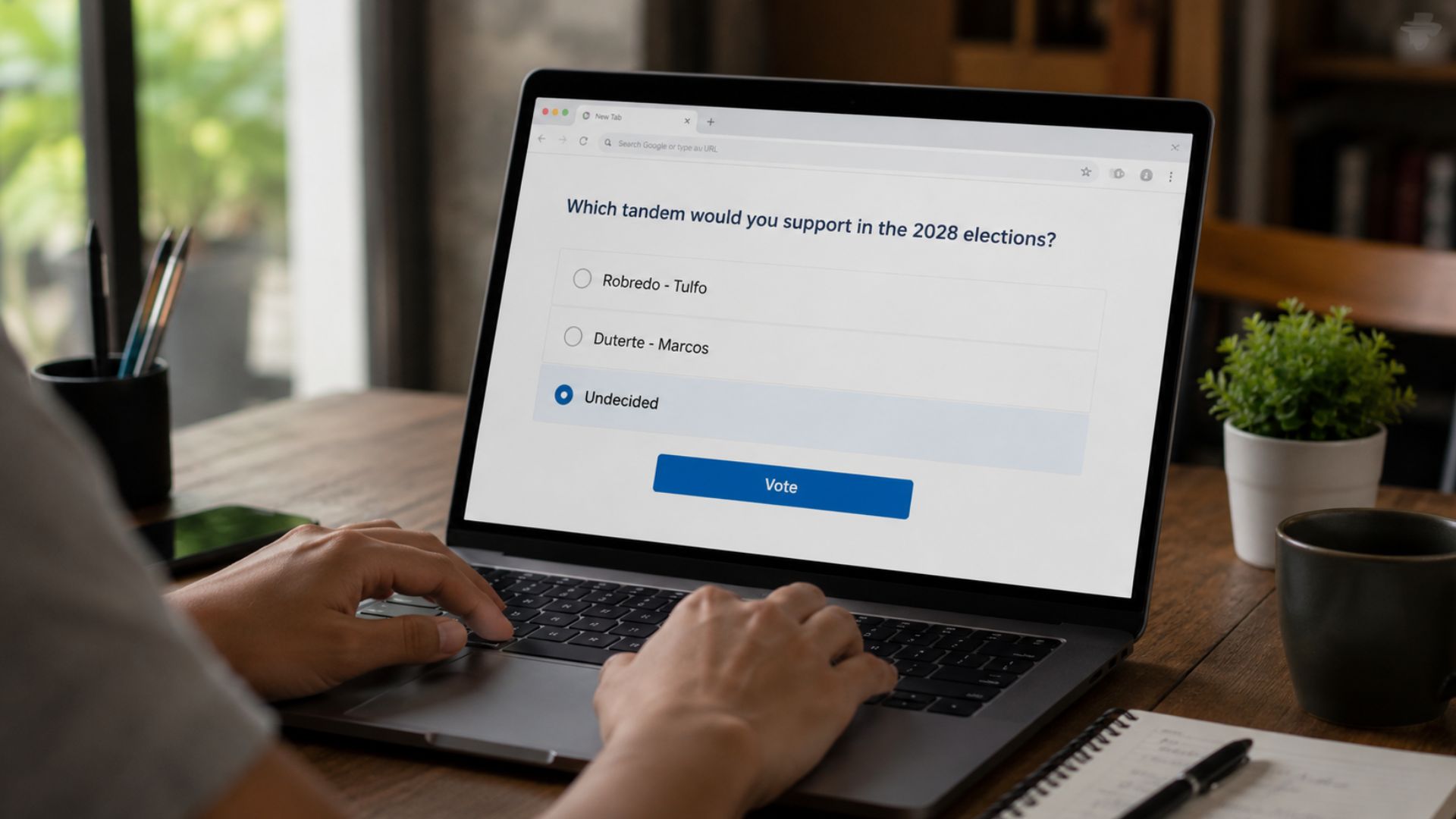







OCTA Research said one of the most important findings from its latest Tugon ng Masa survey may not be the leading tandems themselves, but the large number of Filipinos who remain undecided.
According to OCTA Research, 16 percent of respondents nationwide said they were still undecided between the hypothetical Robredo–Tulfo and Duterte–Marcos tandems for the 2028 elections.
The numbers become even more politically significant in specific sectors. OCTA Research found that undecided voters were highest in Balance Luzon at 20 percent and among Class ABC respondents at 25 percent.
The survey organization said these findings suggest that substantial portions of the electorate remain politically movable and have not yet consolidated around either major coalition.
In many ways, the undecided vote may ultimately become the defining variable of the 2028 election landscape.
Political strategists understand that elections are often won not only through core supporters but through persuadable voters who remain unconvinced until later stages of the campaign cycle. The OCTA Research survey suggests that such voters remain highly influential in the current political environment.
The relatively high undecided levels among Class ABC respondents are particularly noteworthy. Middle- and upper-income voters often shape broader public discourse, business sentiment, and digital conversations. Their hesitation may indicate continuing uncertainty about leadership credibility, governance competence, and political stability.
OCTA Research noted that the findings also reinforce the idea that the current electoral environment remains fluid rather than fixed. Despite increasingly visible polarization, the survey suggests that no coalition has yet fully consolidated national consensus.
Future political developments may therefore have outsized effects on voter behavior. Governance performance, economic conditions, corruption controversies, coalition realignments, and major national events could still substantially alter the balance of the race.
The findings may also indicate that voters are becoming more transactional and less emotionally attached to traditional political loyalties. Many Filipinos may now be evaluating coalitions based not only on identity or personality but also on perceived administrative competence and political viability.
OCTA Research emphasized that the current results should be treated as a snapshot rather than a prediction. Still, the size of the undecided bloc means neither coalition can realistically claim inevitability.
For both camps, the challenge moving forward is not merely energizing loyal supporters but convincing skeptical and movable voters that they offer the more stable, credible, and governable national alternative.
The broader implication of the survey is that the 2028 elections may ultimately be decided not by hardened partisan bases but by voters who remain unconvinced by both sides. In a highly polarized political environment, that undecided middle may eventually become the country’s most important electoral battlefield.